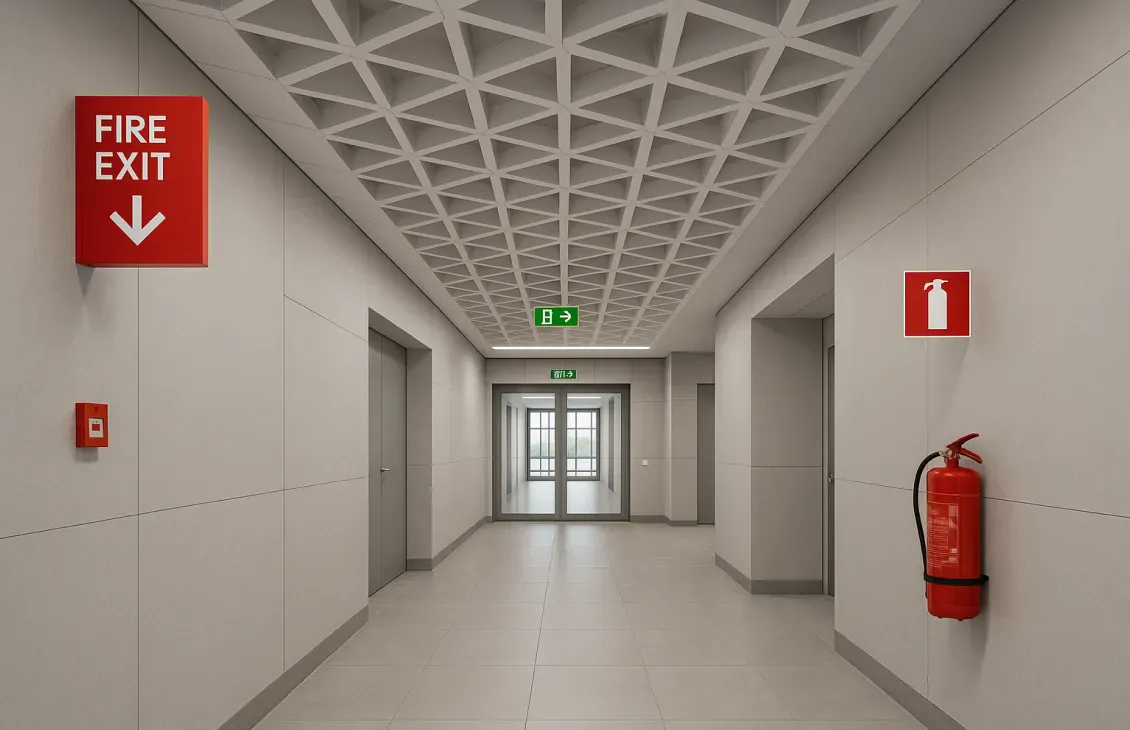
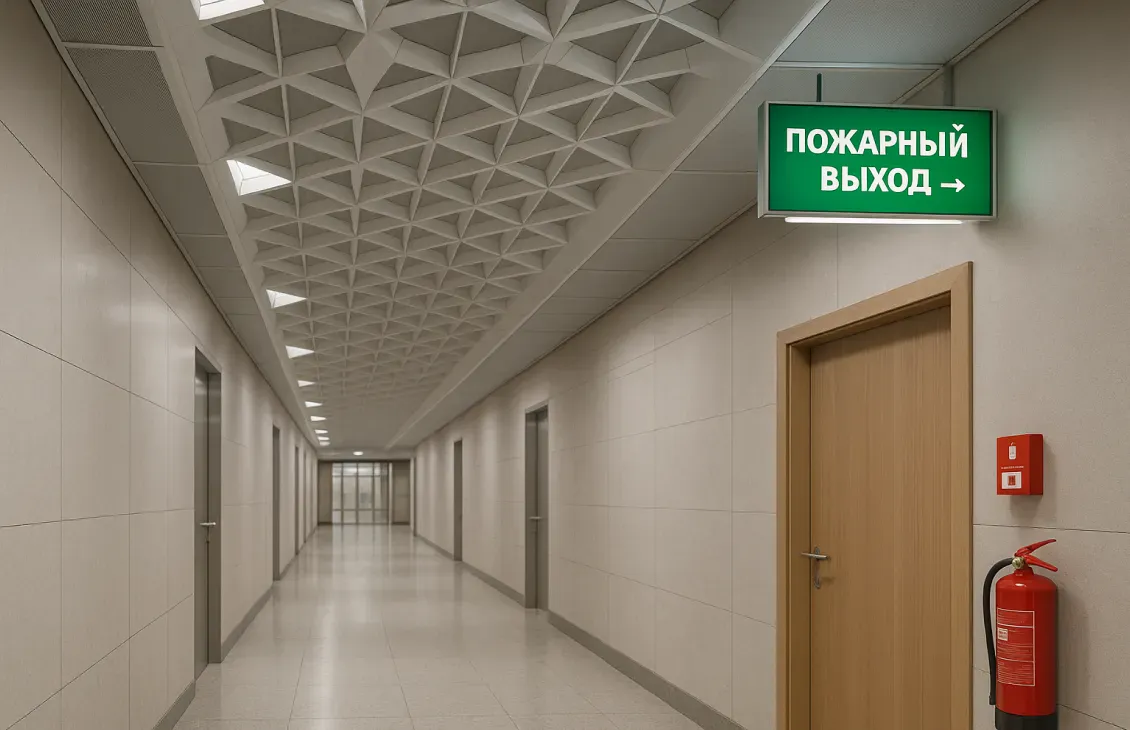
Fire safety is one of the key criteria when selecting finishing materials for public, commercial, and infrastructure facilities. Ceiling systems contribute to the formation of evacuation routes, conceal engineering utilities, and directly influence the spread of fire, heat, and smoke inside a building.
Requirements for ceiling constructions are therefore particularly high: the material must not only retain its geometry and appearance, but also comply with fire safety standards confirmed by official certification.
For modern projects, verified fire safety characteristics are no longer an additional advantage — they are a mandatory condition for the design, construction, and operation of a facility.
Why the Ceiling System Affects the Fire Safety of a Building
The ceiling serves not only a decorative function. It is part of the engineering construction of the space, interacting with the building's life support systems.
The ceiling system simultaneously:
- conceals cable routes and engineering networks;
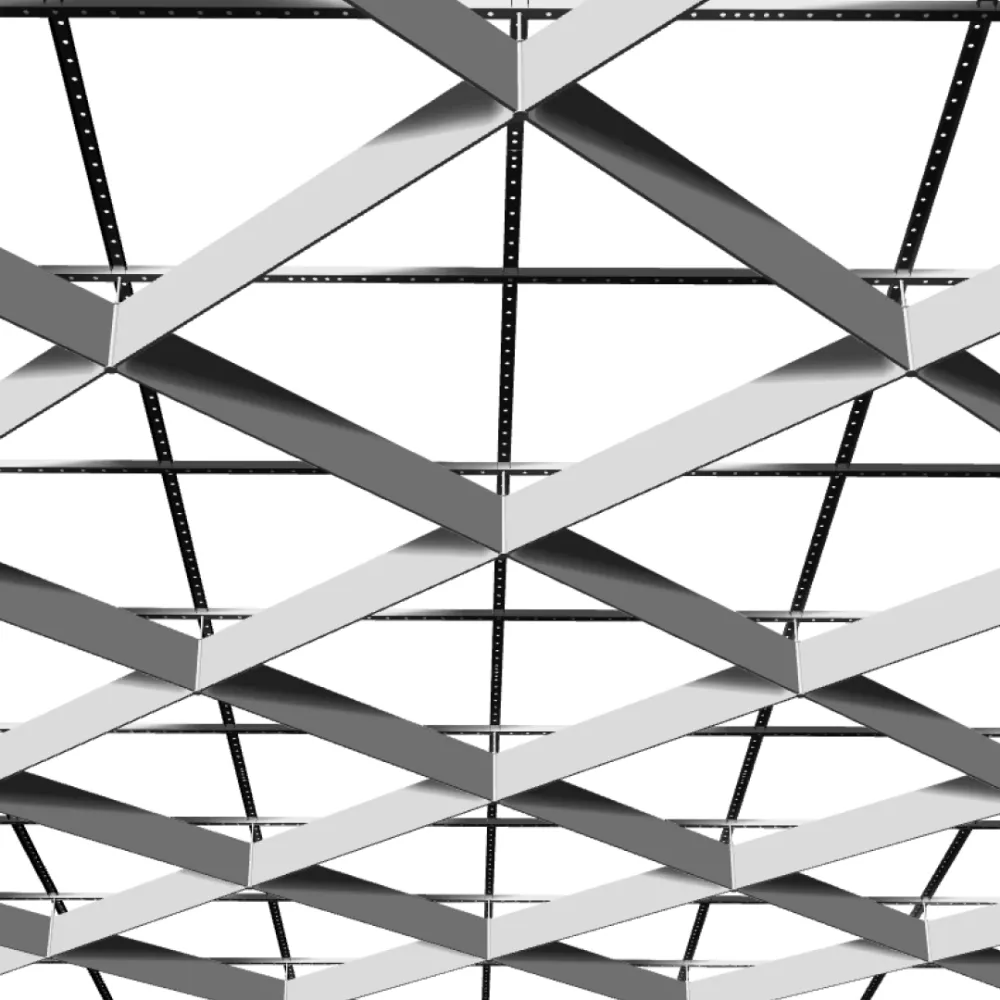
- forms the air volume between the slab and the finishing;
- provides access to ventilation and fire alarm systems;
- influences smoke movement in the event of a fire.
If highly combustible materials are used, the ceiling construction can accelerate fire development and increase the load on evacuation routes.
Why Ceiling System Certification is Critical
Fire certification confirms that the material has been tested and meets established technical requirements.
For designers, developers, and facility owners, this means:
- compliance with regulatory requirements;
- approval for use in public spaces;
- reduced risks during expert review;
- protection against observations from regulatory authorities.
A certified ceiling system allows risks associated with material replacement after a facility enters operation to be ruled out in advance.
What Fire Safety Characteristics Optimus City Ceilings Have
Optimus City ceiling systems are developed with fire safety requirements for facilities of various purposes in mind.
Official certification confirms the following performance indicators:
Polymer Coating
- class G1;
- class B1;
- class D2;
- class T1.
This indicates low combustibility, limited flame spread, moderate smoke generation, and a safe level of heat release.
Anodized Coating
Anodized elements are classified as NG — non-combustible materials.
Such solutions are approved for use in spaces with enhanced fire safety requirements.
Where Optimus City Ceilings Are Approved for Use
Certified ceiling systems are approved for use:
- in evacuation routes;
- in public corridors and lobbies;
- in hotel lobbies;
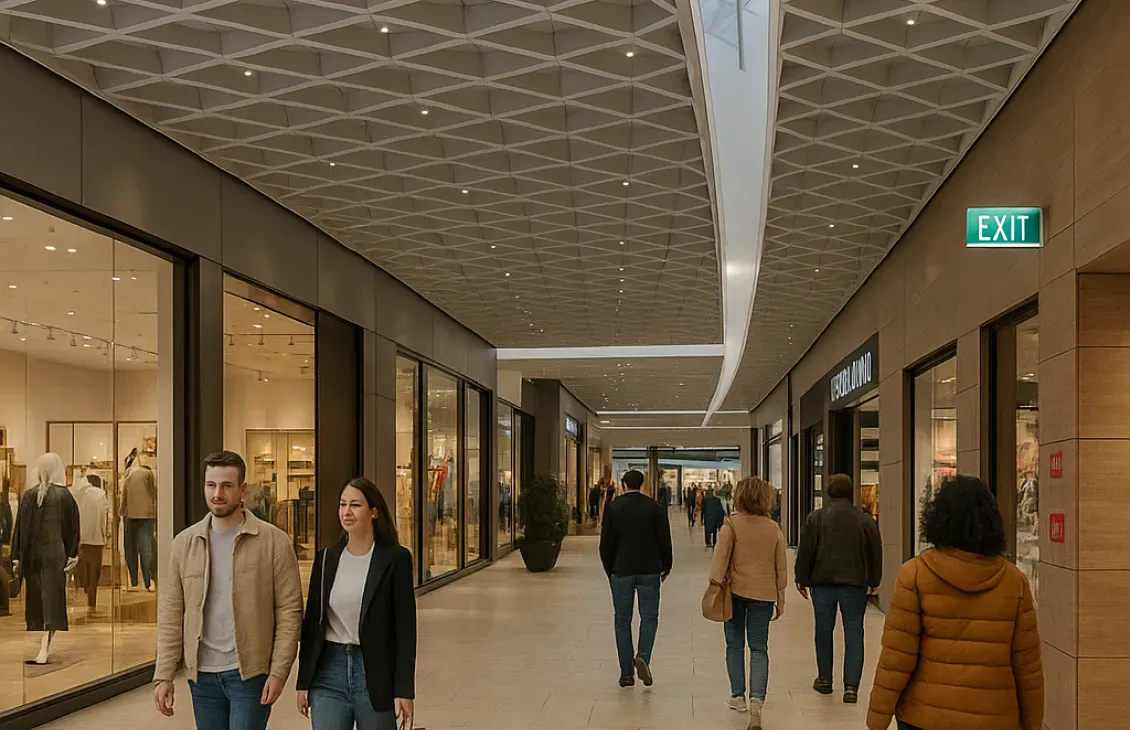
- in shopping centers;
- in airports and railway stations;
- in hospitals and educational institutions;
- in administrative and business spaces.
This makes the system versatile for facilities with various fire safety responsibility categories.
Why This Matters for Designers and Developers
At the design stage, the correct choice of ceiling system directly influences the outcome of expert review and the approval of project documentation.
Using certified solutions allows:
- observations from state expert review to be avoided;
- the project from being returned for revision;
- construction delays to be eliminated;
- the risk of additional costs to be reduced.
For a developer, this means more predictable project delivery.
Operational Durability of Ceilings Throughout Their Service Life
Fire safety is important not only at the time of installation, but throughout the entire operational life of the ceiling.
Optimus City metal ceilings retain their properties thanks to:
- corrosion resistance;
- structural geometry retention;
- coating durability;
- absence of concealed smoldering.
Even after repeated dismantling and reinstallation, the construction retains its operational characteristics.
Why Safety Has Become Part of the Architectural Choice
Modern ceiling systems must combine architectural expressiveness and engineering reliability.
Optimus City unites these requirements: the ceiling system remains aesthetically refined, flexible in design, and compliant with mandatory fire safety requirements.
For modern facilities, this means the ceiling becomes part of not only the design, but also the overall strategy for safe building operation.